
Yashobhoomi (IICC Dwarka): Planning a Stall at a Newer Venue
How to plan a stall at Yashobhoomi, IICC Dwarka: why a newer venue needs more checking, what to confirm, convention-style design and building from Bengaluru.
Yashobhoomi, the India International Convention and Expo Centre at Dwarka in New Delhi, is one of the country's newer venues, used for exhibitions, conferences and large events. The planning principles are the same as at any big venue, but at a newer centre you should rely less on what people remember from past shows and more on the current exhibitor manual and direct answers from the organiser.
This guide covers how to plan a stall where procedures may still be settling, what to check before you commit to a design, and how to design for events that mix conference sessions with an exhibition floor.
Why a newer venue needs more checking
At long-established venues, fabricators and organisers share a lot of working knowledge: which gate trucks use, how power is ordered, how long the queue at the goods lift takes. At a newer venue, some of that knowledge is still being built, and procedures may be updated between shows.
- Treat the current exhibitor manual as the only source of truth, not last year's version or another show's.
- Ask the organiser to confirm venue rules in writing whenever the manual is unclear.
- Do not reuse a design approved at another venue without checking it against this one's rules.
- Expect detailed documentation for contractors and materials, and allow time to prepare it.
- Ask whether there is a site visit or a briefing for contractors before build-up.
What to confirm before design starts
We do not state venue specs from memory, and at a newer venue we are even more careful. These are the questions we put to the organiser for every show.
- Hall, plot, open sides and permitted build height.
- Rules on double-decker stalls, rigging and hanging structures.
- Floor finish, and what protection is required during build-up.
- Power ordering, load limits and the inspection process.
- Fire safety rules and the material certificates needed.
- Vehicle routes, unloading points, goods lifts and size limits for crates.
- Build-up and dismantle hours, and rules on noise or dust during build-up.
- Contractor registration, passes, deposits and the safety gear required for crew.
Floor protection deserves special mention. Modern venues usually want their finished floors protected during build-up and dismantle. Ask what is required, and plan the platform and installation method around it, because it affects how long the build takes.
Restrictions on on-site work
Some venues limit cutting, sanding, spray painting or other dusty work inside the halls. Ask whether this applies to your show. If it does, every part must arrive finished, and the crew assembles rather than builds. That is how we work anyway: the stall is completed and dry-assembled at our factory before it travels.
Designing for convention-style events
Many events at a convention centre combine conference sessions with an exhibition. Visitors come out of sessions in waves, spend a break in the exhibition area and go back in. That changes how a stall should work.
- Design for short, busy peaks during session breaks, with quiet periods in between.
- Make your message readable at a glance; there is little time for browsing.
- Put lead capture at the front, quick and easy, with a QR code or a tablet.
- Give people a reason to come back: a scheduled demo, a meeting slot or a short talk at the stall.
- Keep finishes refined. Conference audiences notice quality and notice shortcuts.
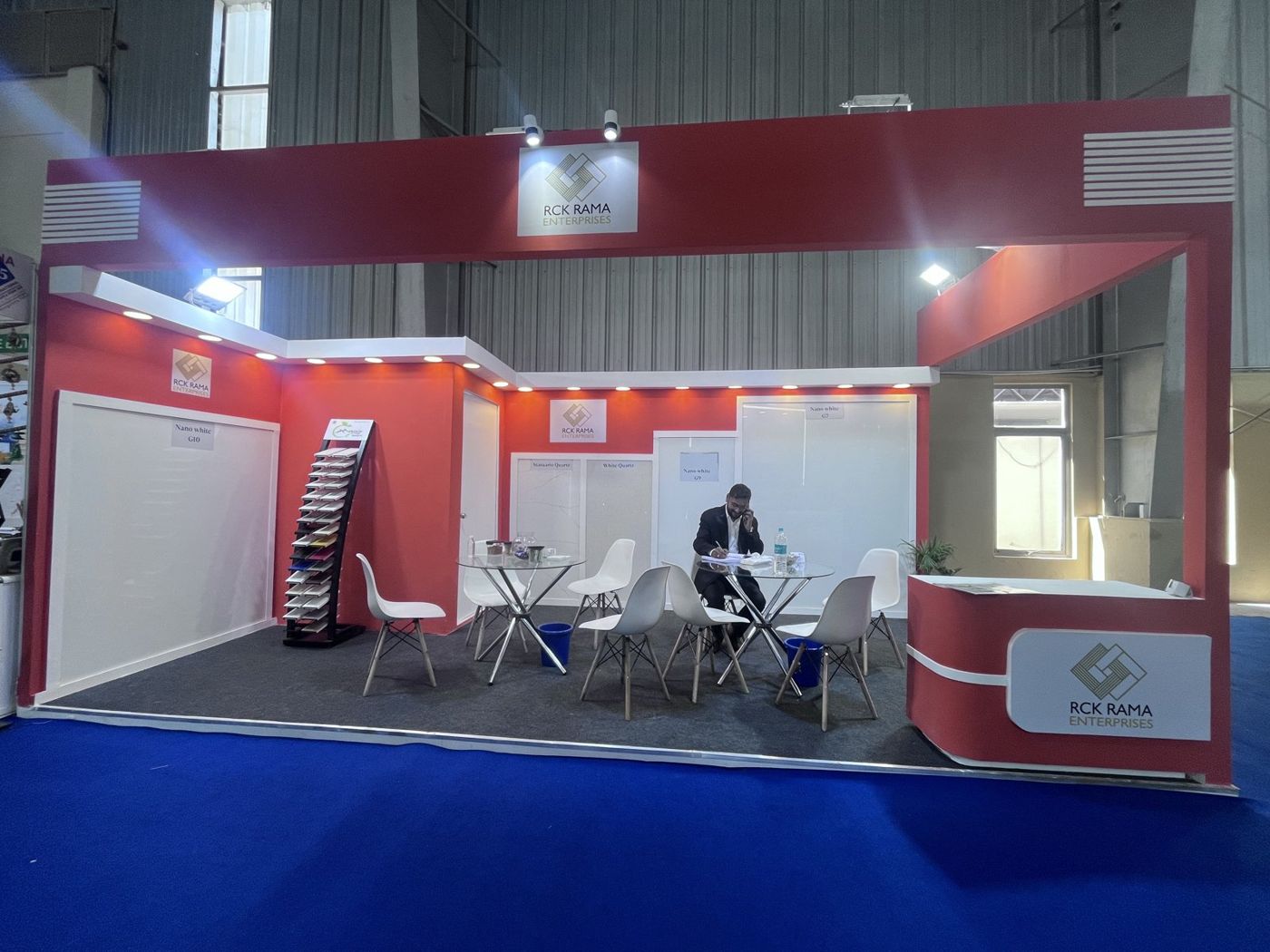
Ask the organiser for the session timetable as soon as it is published. Plan staffing so your best people are on the stall during breaks, and use the quiet periods for follow-up calls, restocking and pre-booked meetings.
Building from Bengaluru for a Delhi venue
We build in Bengaluru, so for Delhi NCR venues we ask for a brief 6–8 weeks ahead. The stall is fabricated and dry-assembled at our factory, packed in sections sized to the venue's access, and trucked to Delhi with our crew, who install it, stay through the show and dismantle.
The same stall can serve more than one Delhi venue. If you exhibit at Bharat Mandapam and Yashobhoomi in the same season, a modular design can be adapted to both plots with new graphics, as long as it meets each venue's rules. Our exhibition stalls page explains how we plan stalls that travel.
Mistakes to avoid at a newer venue
- Assuming the build-up window is the same as at another Delhi venue.
- Ordering power late because the process was different last time.
- Arriving with crates too large for the venue's lifts or doors.
- Bringing crew without the required passes, documents or safety gear.
- Leaving the organiser's comments on drawings unanswered until build-up.
- Planning on-site painting or cutting without checking whether it is allowed.
None of these is difficult to avoid. Each one simply needs a question asked early and the answer written down where the whole team can see it.
A simple habit helps: keep one shared sheet with every rule, deadline and contact for the show, and update it whenever the organiser sends a circular. Newer venues tend to issue updates as they refine their processes, and the team that reads them on time is the one that builds without surprises.
Planning a stall at Yashobhoomi?
Send us the event, your space and the exhibitor manual, and we will plan the stall and the logistics. Start with Plan your project, see the Yashobhoomi venue page and our New Delhi page, or WhatsApp or call +91 70190 58391.