
Why We Dry-Assemble Every Stall in the Factory Before It Ships
A full trial build in the factory catches fit, finish, lighting and graphic problems before the truck leaves, while fixing them is still quick and cheap.
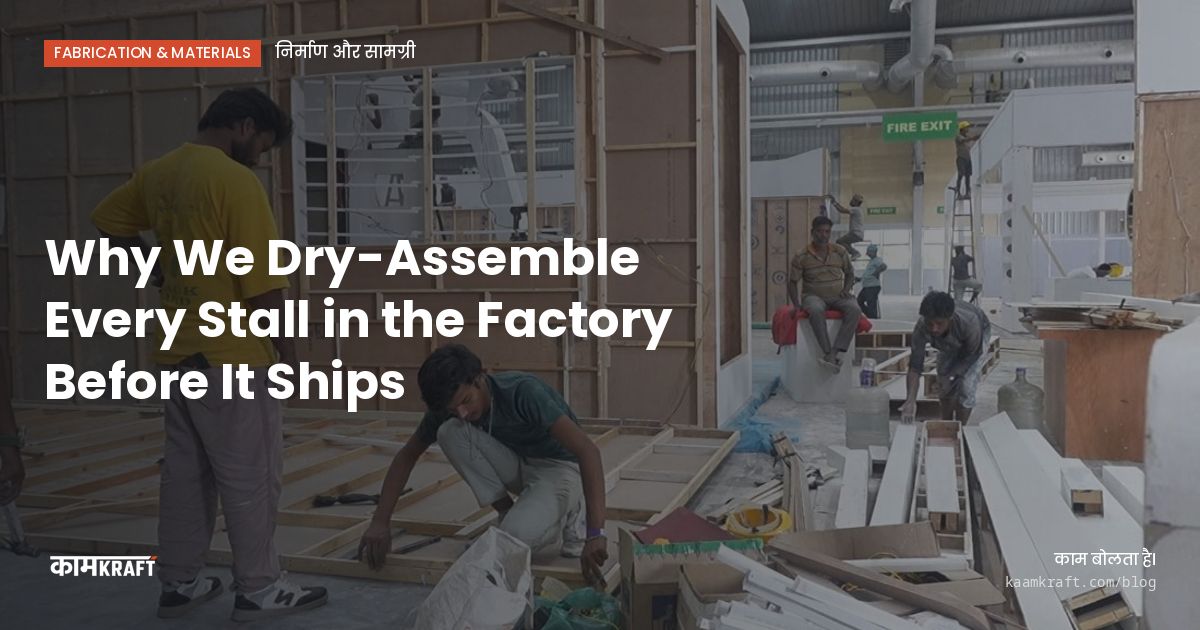
Because problems found in the factory take hours to fix, and the same problems found at the venue can eat a whole build-up day, or not get fixed at all. A dry assembly is a full trial build of the stall on our factory floor, put together exactly as it will stand at the show, with lights on and graphics in place.
It costs factory time and floor space, and some fabricators skip it to save both. We do not, because build-up days at a venue are short, shared with every other exhibitor and run to the organiser's timetable. The venue is the worst place to discover that a panel does not fit.
What a dry assembly actually involves
The crew builds the stall from its labelled parts, using only the drawings and the fixings that will travel with it. No extra cutting and no factory-only shortcuts. If it cannot go up in the factory with the packed kit, it will not go up at the venue either.
Once it is standing, we switch on every light, connect screens to test points, fit graphics and place sample products where we can. Then we walk it as a visitor would, from the aisle, and as your staff would, from behind the counter and inside the store room.
What it catches
- Panels a few millimetres out that leave visible gaps at joints
- Wall runs that lean or twist once the full height is up
- Graphics that land on a joint, wrap a corner badly or do not match the colour proof
- Lights that leave dark patches or glare into visitors' eyes
- Doors, drawers and showcase locks that stick
- Cable routes too short to reach the planned power point
- Fascia and header joints that need extra bracing
None of these is dramatic on its own. Together, on a stall assembled for the first time at a venue, they are the difference between a crisp stand and one that looks patched together on the morning of the show.
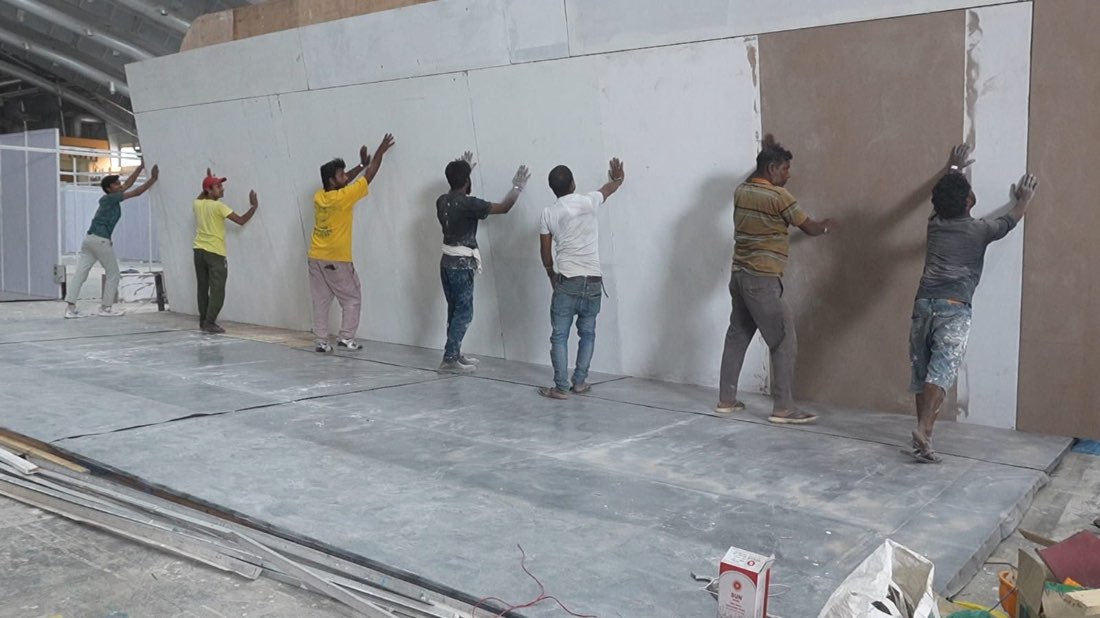
Why fixing it at the venue is harder
At the venue, the crew has limited hours, limited tools and limited space. Cutting, sanding and painting may be restricted under the organiser's rules, so check the exhibitor manual for what work is allowed on site. Replacement material may be hours away, and a paint touch-up done in a dusty hall rarely matches a factory finish.
The further the show, the bigger the risk. For a stall going from Bengaluru to India ITME 2026 at India Expo Mart, Greater Noida, from 4 to 9 December 2026, there is no quick trip back to the factory for a remade panel. The dry assembly is the last chance to get it right with the full workshop at hand.
What it gives you as the client
The trial build is the best time to see your stall. Renders are useful, but standing inside the real thing tells you more about scale, colour and how the counter feels to work at. We invite clients to walk the stall at our Bengaluru factory, or we send a detailed video walkthrough if they cannot visit.
Changes are still possible at this stage: moving a shelf, adjusting a graphic, adding a light. They are far easier now than after the stall is packed. We ask you to sign off the stall as built, so everyone agrees on exactly what will arrive at the venue.
What to check on your walkthrough
- Logo position and size, seen from the aisle at a distance
- Graphic colours against your brand colours, under the stall's own lights
- Counter height and storage access for your staff
- Product display spacing, with real or dummy products
- Screen positions and viewing angles from where visitors will stand
- Anything that feels different from the render
How it speeds up the venue build
A dry assembly also produces a build sequence. The crew learns which panel goes first, where the tricky joints are and how long each stage takes. Parts are then packed and loaded in reverse order of assembly, so they come off the truck in the order they are needed.
That means a calmer, faster build at the venue, and more time left for cleaning, final light focusing and product placement before the show opens. It is a standard step in every exhibition stall we build, not an optional extra.
Questions clients often ask about it
Does it add time to the schedule?
It adds some factory time, more for larger stalls, and we plan for it from the start rather than squeezing it in at the end. It usually saves more than that at the venue, where every hour is fixed by the organiser's build-up timetable and shared with every other exhibitor in the hall.
Can a stall be too big to dry-assemble?
Very large stalls, or double-deckers, may be trial-built in sections rather than all at once. In that case we assemble the parts that join each other, such as wall runs with their fascia, or the upper deck with its stair, so every critical joint is still tested before it leaves.
What if the venue space turns out different?
The trial build is done to the space shown on the organiser's allotment. If the space on the ground differs, the crew already knows the stall well enough to adapt it quickly, which is far easier than improvising with a stall nobody has seen standing before. Confirm your space dimensions and open sides with the organiser early, so surprises are rare.
Next step
If you want your next stall built and trial-assembled before it ships, share your show and space at Plan your project, or WhatsApp or call +91 70190 58391. We will build a factory walkthrough into the schedule.