
Stall Fabrication in Bengaluru: Building Near the Factory City
Why building a stall near the factory city saves time and risk, how far a Bengaluru-built stall travels across India, and how to plan for each distance.
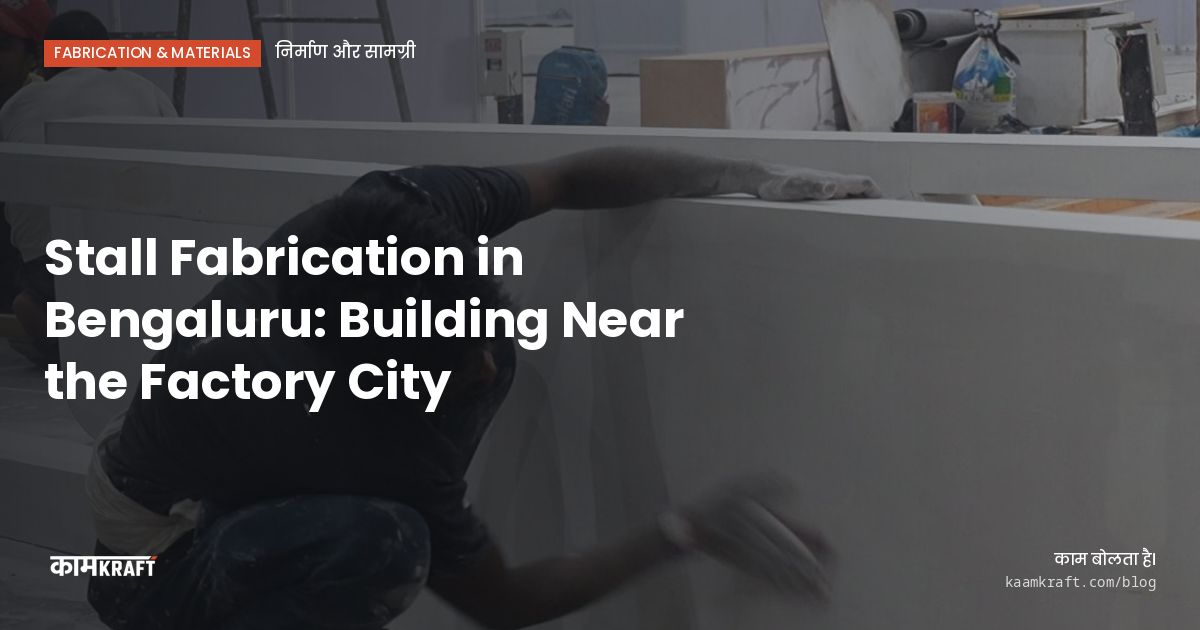
The closer your show is to the factory, the more of the schedule goes into building and the less into travel. For shows in Bengaluru, a factory-built stall can be finished, trial-assembled and walked by your team, then reach the venue with almost no transit risk. For shows elsewhere in South India and the rest of India, the same stall travels by road, so the plan needs more lead time and more careful packing.
Our factory has been in Bengaluru since 2018. Here is what building near the factory city means in practice, how far our stalls travel, and how to plan for each distance.
What a nearby factory changes
- More build time, because no long road journey eats into the schedule
- Easy client visits, so your team can walk the trial assembly in person
- Fast fixes, since a forgotten part or remade panel can reach the venue quickly
- Less handling, with fewer loading and unloading cycles and less transit damage
- Simpler storage and reuse, because the stall comes back to the same workshop
Shows at BIEC, such as Bengaluru Tech Summit 2026 from 17 to 19 November 2026, and at KTPO Whitefield benefit most. For these, we ask for a brief 3 to 4 weeks ahead. Our Bengaluru stalls page has more on local shows and venues.
Why the walkthrough matters more than it sounds
When the factory is a short drive away, your marketing team can stand inside the finished stall, check colours under its own lights and move a shelf before anything is packed. For shows further away, we send video walkthroughs instead, but nothing replaces seeing the real thing. Many of the best changes to a stall come from that one visit.
A nearby factory also helps after the show. The stall can come straight back for inspection, storage and refresh, so the next local show starts from a stall you already own rather than from a blank page.
Across South India
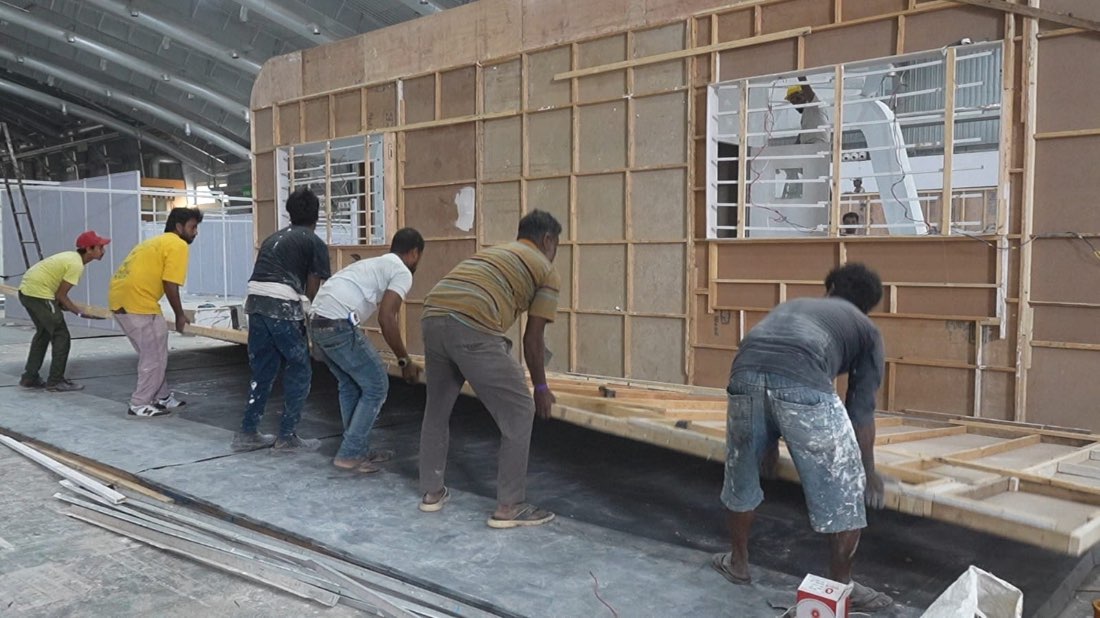
Chennai, Hyderabad, Kochi and Coimbatore are within road reach of Bengaluru, and we build for all of them from the same factory. Travel adds time, so we ask for a brief 4 to 6 weeks ahead. The stall is packed for the road, and the crew travels to reach the venue with or ahead of the truck.
For these cities the trade-off is small. You keep the factory finish and the trial assembly, and add road time and a little more packing care. See our pages for Chennai, Hyderabad, Kochi and Coimbatore. Paperex South India at Chennai Trade Centre, 3 to 5 December 2026, and India Diagnostic Expo at HITEX Hyderabad, 18 to 20 December 2026, are typical examples.
Further afield: Mumbai and Delhi NCR
For shows in Mumbai or Delhi NCR, a Bengaluru-built stall travels a long way. We plan 6 to 8 weeks for these, because road time, a safety margin and the organiser's vehicle entry windows all come out of the factory schedule.
It still works well for most stalls, because the finish and the trial build happen where the tools and skilled people are. It does need stronger crating, lighter skins where possible, spare parts on the truck and a plan for touch-ups at the venue. For shows such as IITF 2026 at Bharat Mandapam, 14 to 27 November 2026, or India ITME 2026 at India Expo Mart, 4 to 9 December 2026, this planning is standard.
The biggest risk on long routes is a late design change. Once the truck has a fixed departure date, there is no slack to rebuild a wall or reprint a large graphic. So for far shows we push for design and artwork sign-off earlier, and we pack a small kit of spare graphics, lights and fixings that can solve common problems on site.
It also helps to think about the return trip. A stall built in Bengaluru for a Delhi or Mumbai show can come back to the factory for storage and reuse, or be stored nearer to where you exhibit most often. That choice depends on your show calendar for the next year.
When a local build might be better
Sometimes building close to the venue is the better choice: very large stalls that would fill several trucks, very tight timelines, or simple structures where transport outweighs the value of a factory finish. In these cases a hybrid can work, with feature elements built in Bengaluru and basic structure sourced near the show.
We will tell you plainly which option suits your show. The useful question is where the quality of your stall is decided. For most stalls, it is decided in the factory, by people who have built the same kind of joint and finish many times before.
How to plan by distance
- Fix the show dates and venue, then count back using the lead times above.
- Confirm build-up dates and the design approval deadline in the organiser's exhibitor manual.
- Lock the design early for far shows, since late changes cost more when travel time is fixed.
- Plan a factory walkthrough before packing, in person or by video.
- Decide whether the stall comes back to Bengaluru for storage after the show.
Our factory page shows how the build itself works, from framing to trial assembly.
Planning a stall?
Tell us your show and city, and we will plan the build and the journey from our Bengaluru factory. Start with Plan your project or WhatsApp or call +91 70190 58391.