
Packing and Transporting an Exhibition Stall Across India
How a stall is packed, loaded and trucked from a Bengaluru factory to venues across India: crating, load order, timing, paperwork and venue entry rules.
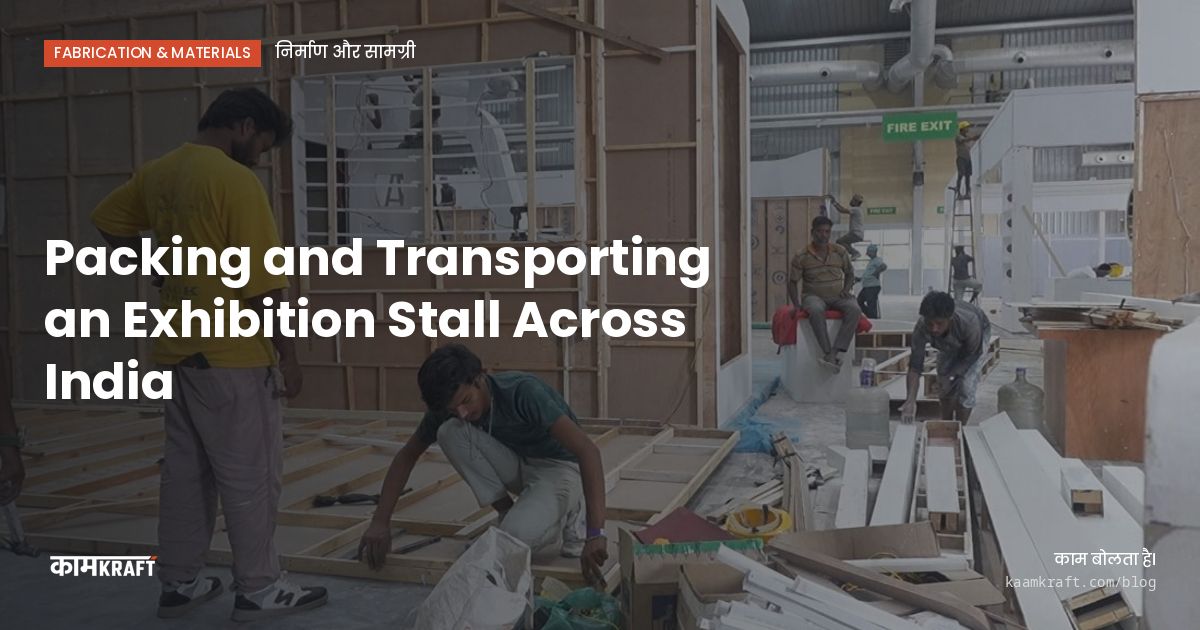
A stall travels safely when it is packed in the order it will be built, protected according to how fragile each part is, and loaded so nothing shifts on the road. Timing matters just as much: the truck has to reach the venue inside the organiser's build-up and vehicle entry windows, which means leaving the factory with a margin for delays.
Our stalls leave our Bengaluru factory for shows across South India and beyond. Here is how we approach packing and transport, and what exhibitors should know when their show is a long way from the workshop.
Packing starts in the drawings
How a stall packs is decided when it is designed. Panels are sized to fit the vehicle and the venue doors, fixings are chosen so parts separate without damage, and fragile elements are planned as removable pieces. A wall that looks continuous may be built in sections for exactly this reason.
After the trial assembly in the factory, the stall is dismantled in a set order and every part is labelled with its position on the stall and its crate or bundle number. A packing list travels with the truck and another with the site lead. The crew at the venue should never have to guess what goes where, or wonder whether something was left behind.
Protecting each type of part
Not everything needs a crate, and crating everything wastes space and adds weight. We match protection to the part:
- Painted and laminated panels: wrapped and stacked face to face with padding, edges protected with corner guards
- Glass and large acrylic: separate crates with fixed positions inside
- Lit letters, lightboxes and screens: padded crates, never loose in the load
- Platforms and frames: bundled and strapped, since they often form the base of the stack
- Electricals: boxed and labelled by zone, with spare lights and connectors
- Graphics: rolled on tubes or folded as specified, and kept dry
- Tools, fixings and touch-up kit: their own labelled boxes, easy to reach on arrival
Moisture is easy to forget. A load can sit in a truck through rain or humid coastal air, and board-based panels and printed graphics do not like it. Wrapping and keeping parts off the truck floor matters on every route, not only in the monsoon.
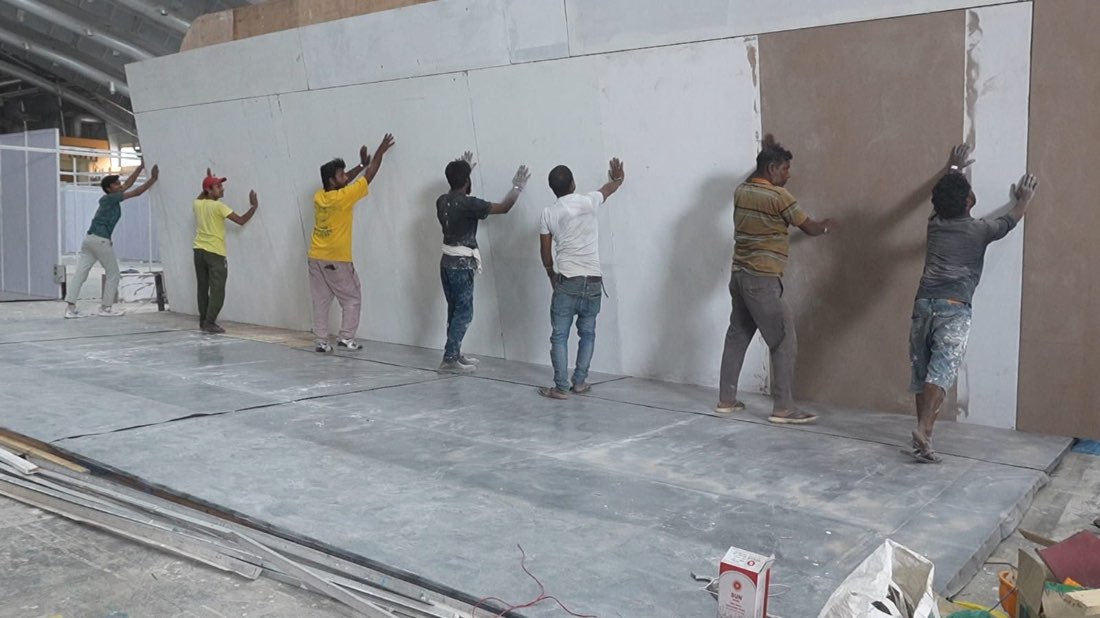
Loading the truck
Load order matters as much as packing. Parts needed first at the venue, like floor platforms and base frames, need to come off first, so they go in last. Heavy items go low, fragile crates sit where nothing can fall on them, and everything is strapped so it cannot slide when the driver brakes.
For a larger stall, two vehicles are often better than one overloaded one. A crowded truck means more handling, more rubbing between parts and more damage. We plan vehicle size from the dry-assembled stall, not from the render, because only the real stall tells you how much space it takes when packed.
Timing and distance
Road time comes straight out of the factory schedule. A show in Bengaluru leaves the most build time. A show in Chennai, Hyderabad, Kochi or Coimbatore adds road time to the plan. Mumbai and Delhi NCR add much more, and the plan needs a margin for traffic, checkpoints, breakdowns and weather.
This is why our lead times grow with distance: a brief 3 to 4 weeks ahead for Karnataka, 4 to 6 weeks for the rest of South India and 6 to 8 weeks elsewhere. For IITF 2026 at Bharat Mandapam, from 14 to 27 November 2026, the truck has to leave Bengaluru well before build-up begins. Shows at the Bombay Exhibition Centre, such as ACETECH Mumbai from 19 to 22 November 2026, need the same kind of planning.
The crew usually travels separately and is planned to reach the venue before or with the truck, so no time is lost waiting for people once the load arrives.
Paperwork and venue entry
Moving goods by road between states needs proper documentation, and the requirements can change, so your logistics partner and accountant should confirm what is needed for your consignment. Keep copies with the driver and with the site lead, and include products and demo equipment you are sending separately.
Venues control when and where trucks can enter, unload and park. The organiser's exhibitor manual usually covers vehicle passes, unloading points, time slots and whether material handling must be booked through an official contractor. Check these before you fix a dispatch date:
- Build-up dates and hours, and whether vehicles need passes in advance
- The unloading point and the route from it to your hall
- Whether forklifts or cranes must be booked through the official contractor
- Where empty crates and packing can be kept during the show
- Dismantling times and when vehicles can come back for loading out
- Any rules on vehicle size or how long a truck may stay inside the venue
Empty crates matter more than people expect. If the venue has no space for them, they may need to go back on the truck and return for dismantling, which affects how you book the vehicle.
When building closer to the show makes sense
For very far shows or very large stalls, it can make sense to fabricate simple structure near the venue and transport only the feature elements from the factory. That trade-off depends on finish quality, supervision and cost. For most stalls, and nearly all South India shows, factory-built and trucked is the more reliable route, because the finish and the trial build happen where the tools and the skilled hands are. Our locations page shows where we deliver.
Planning a stall?
Tell us your show and venue, and we will plan the build, packing and transport backwards from your build-up date. Start with Plan your project or WhatsApp or call +91 70190 58391.