
Hanging Banners and Rigging Above a Stall: What to Plan
Planning a hanging banner or rigged structure above your exhibition stall: when it helps, what to check in the exhibitor manual, design, deadlines and safety.
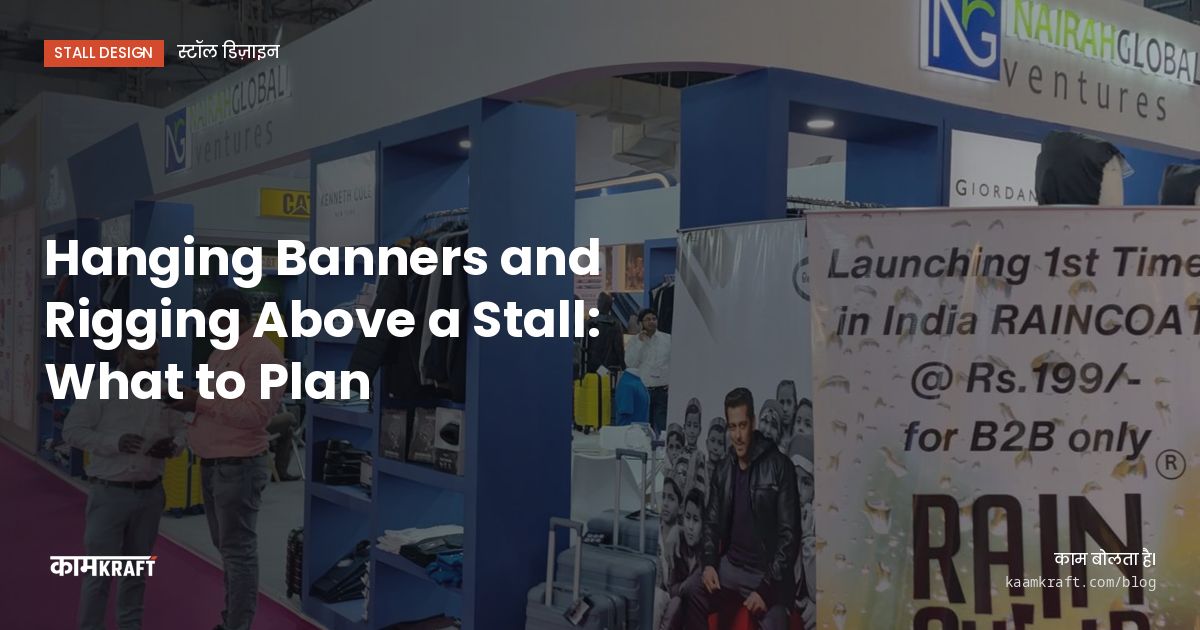
A hanging banner lets visitors find your stall from across a crowded hall, but it is controlled more tightly than anything else on the stand. Whether you can hang anything, how high, how heavy and who installs it depends entirely on the venue and organiser. Read the rigging section of the exhibitor manual first, confirm it is allowed for your stall type, and plan the design and deadlines around those rules.
In many halls, only the venue's approved riggers can attach anything to the roof, and they need drawings and weights well before build-up. Leaving it to the last week usually means it does not happen.
When a hanging banner is worth it
- Large halls where stalls at floor level are hard to see past neighbours.
- Island and large peninsula stalls, where an overhead sign marks the centre of the space.
- Stalls that visitors will be looking for, such as key suppliers or sponsors.
- Shows where the organiser restricts wall height, but allows suspended elements above it.
On a small inline stall in a low hall, a banner may not be allowed or may not add much. A well-lit fascia at the front of the stall often does the same job. A raised logo panel above the back wall, within the allowed height, is another option for smaller stalls.
What to check in the exhibitor manual
Rules vary by venue and organiser, so we never assume them. These are the questions to answer from the manual or the organiser before you design anything overhead.
- Is suspended branding allowed at all, and for which stall types or sizes?
- Is there a minimum and maximum height for the banner, measured from the floor?
- Is there a maximum weight per rigging point or for the whole structure?
- Must the banner sit within the stall footprint, or set back from the edges?
- Who installs it: the venue's own rigging team, an approved contractor, or your fabricator?
- What drawings, weights and material details must be submitted, and by what date?
- Are there fire safety requirements for the banner material?
- Are there separate charges for rigging points, lifts or labour that need ordering in advance?
Some venues have fixed roof points at set positions, so the banner may not hang exactly where you want it. Ask whether the rigging grid allows a point over your stall, or whether the banner has to be hung from a frame between points. The venue page for your hall, for example Bharat Mandapam or BIEC Bengaluru, is a good starting place, but the exhibitor manual for your specific show is what counts.

Banner shapes and materials
Shapes
Common shapes are rings, squares, triangles and straight panels. A ring or square with graphics on all faces suits an island stall, since it can be read from every aisle. A single flat panel suits a stall seen mainly from one direction. Keep the shape simple: complex shapes add weight and make the rigging harder to approve.
Materials
Overhead structures are usually a light frame, often aluminium, with printed fabric stretched over it. Fabric keeps the weight down, folds small for transport and can be reprinted for the next show. Rigid panels are heavier and more likely to hit weight limits. Ask your fabricator whether the fabric is fire retardant, because organisers may ask for proof.
Graphics
A banner is seen from far away and from below. Use your logo and perhaps one short word or line, nothing more. Large, simple, high-contrast graphics work. Product photos and small text do not.
Stall-mounted alternatives
Where roof rigging is not allowed, too expensive or too slow to arrange, a tall element built up from the stall itself can do a similar job. A raised fascia frame, a tall lit column or a header supported on the stall structure all add height without hanging from the roof.
These still have to follow the organiser's height rules, and very tall elements may need structural details submitted for approval. The advantage is that your fabricator can build and test them in the factory, and they can often be reused at the next show.
Timeline and safety
Overhead elements usually have earlier deadlines than the rest of the stall. Build them into your plan from the first design meeting.
- Confirm in the manual whether rigging is allowed before the design is finalised.
- Fix banner size, shape and weight early, so drawings can be submitted on time.
- Order rigging points or services by the organiser's deadline.
- Plan the install slot: banners are often hung before the stall is built, because lifts need a clear floor.
- Check the banner's height against your stall's tallest element so they do not clash.
- Plan how it comes down at dismantling, and by whom.
We design and build overhead frames and stall-mounted headers in our factory, test-fit them with the stall, and coordinate with the venue's riggers on site. For shows such as IITF 2026 at Bharat Mandapam, 14 to 27 November 2026, plan any overhead branding at the very start, since lead times from Bengaluru to Delhi are already 6 to 8 weeks.
Next step
Share your show, stall number and the exhibitor manual if you have it. We will check what overhead branding is allowed and design something that can be approved and installed on time. Start with Plan your project, or WhatsApp or call +91 70190 58391.