
The Exhibitor Manual: What to Read First and Deadlines That Matter
The exhibitor manual sets your deadlines and stall rules. What to read first, what to check on height, power and build-up, and how to track every due date.
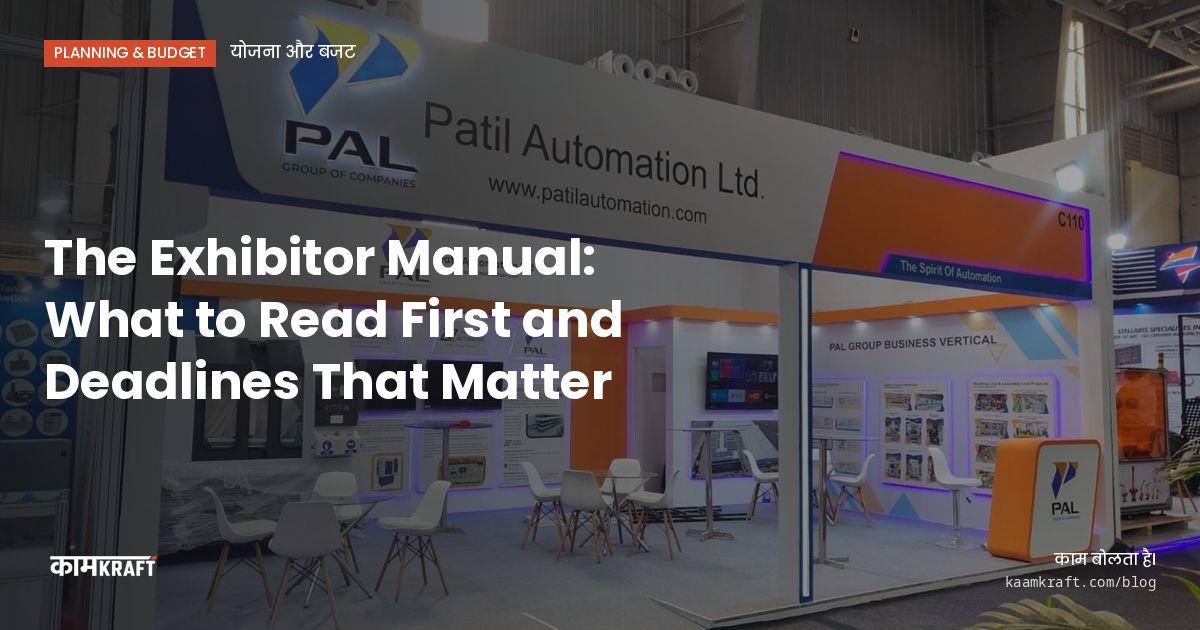
The exhibitor manual is the rulebook for your show. It tells you how high you can build, what needs approval, when power must be ordered, when your crew can enter the hall and when everything must be gone. Read the deadline schedule first, then the stall construction rules, then the sections on electrical work, build-up and dismantling.
Everything else, from catalogue entries to furniture rental, can wait a few days. Those first four sections decide whether your stall can be designed the way you want and whether you will be paying late fees. Here is what to look for in each, and why it matters.
Start with the deadline schedule
Most manuals have a table of forms and due dates near the front or back. Copy it into your own calendar on the day the manual arrives. Names and dates differ from show to show, but these are the deadlines that usually carry the most weight.
- Stall design submission for bare space, often with a separate, later date for revised drawings.
- Contractor registration, which may require your fabricator's details, insurance and a deposit.
- Power and electrical load order, which is commonly cheaper before the deadline and charged extra after it.
- Rigging requests if anything hangs from the hall roof.
- Exhibitor badges, contractor passes and vehicle passes for build-up days.
- Catalogue or directory entry, which is your free listing and is easy to miss.
- Freight, advance warehousing or heavy exhibit entry, if the show offers them.
Mark each deadline a week early in your own plan. Approvals often need a revision round, and forms often need inputs from someone else, such as your fabricator's load calculation or your finance team's payment.
Stall construction rules
This section shapes the design, so share it with your stall designer before the first sketch, not after. Every show writes its own rules, so check each of these points in the manual rather than assuming last year's show was the same.
- Maximum build height, and whether a lower height applies near the boundary with neighbours.
- Setbacks from aisles and neighbouring stalls, and how much of each open side may be closed with walls.
- Whether walls facing neighbours must be finished cleanly on the back.
- Rules for double-decker stalls, covered ceilings and hanging structures, including any engineer's certificate.
- Platform height limits and whether a ramp is needed for accessibility.
- Material rules, especially fire-retardant treatment for timber, fabric and carpet.
Height and open-side rules matter most because they change the structure. A tall backdrop that has to come down by a metre is a redesign, not a small edit. Our exhibition stall process puts these limits into the design brief at the start for that reason.

Electrical and services
The electrical section tells you how to order power, what connection types are available, who makes the final connection to the hall supply, and when power goes live. Check whether supply is available during build-up or only from a certain day, and whether it is switched off overnight during the show.
Overnight shut-off matters if you have fridges, servers or equipment that cannot lose power. Some shows let you order a separate continuous supply. If you plan live demos with machines, ask the manufacturer for running and start-up loads and pass them to your fabricator before the order form is due.
Build-up and dismantling
Build-up rules decide how your crew works. Look for entry dates and hours, vehicle timings, where trucks unload, whether night work is allowed, and the time by which stalls must be finished for inspection. Dismantling rules matter just as much: when you may start, when the hall must be clear, and what happens to anything left behind.
Large venues have their own logistics on top of show rules. If you are exhibiting at Bengaluru Tech Summit 2026 from 17 to 19 November, read the show manual alongside what you know about BIEC Bengaluru, since unloading points and walking distance from the dock affect how fast a crew can work.
Give the manual an owner
The most common reason exhibitors miss deadlines is that nobody owns the manual. It sits in someone's inbox while everyone assumes someone else has read it. Give one person the job and a short checklist.
- Read the deadline schedule and stall rules within two days of receiving the manual.
- Send the full manual and your stall number to your fabricator on the same day.
- Build a calendar of every due date, set a week early, with a named person against each form.
- Track approvals and payments in one sheet that both your team and your fabricator can see.
- Re-check the manual for updates or circulars from the organiser in the last month before the show.
For a big machinery show such as India ITME 2026, held from 4 to 9 December 2026 at India Expo Mart, Greater Noida, heavy exhibit entry and foundation rules may have their own early dates. That is exactly the kind of detail an owner catches and a busy team misses.
When the manual is unclear
Manuals are sometimes vague, out of date or silent on the exact thing you need, such as whether a particular material is allowed or whether a wall counts as closing an open side. Do not guess. Email the organiser's operations contact with a specific question and, where useful, a sketch. Keep the reply, because a written answer is what settles a disagreement with an inspector during build-up. Your fabricator should be copied on these emails so the factory works from the same answer you received.
Next step
Send us your manual and stall details and we will read the construction and electrical sections with you before the first design. Plan your project here, or WhatsApp or call +91 70190 58391.