
What Happens on Build-Up Days at an Exhibition Venue
What happens during stall build-up at the venue: unloading, marking out, assembly order, power, cleaning and handover, and what exhibitors should do.
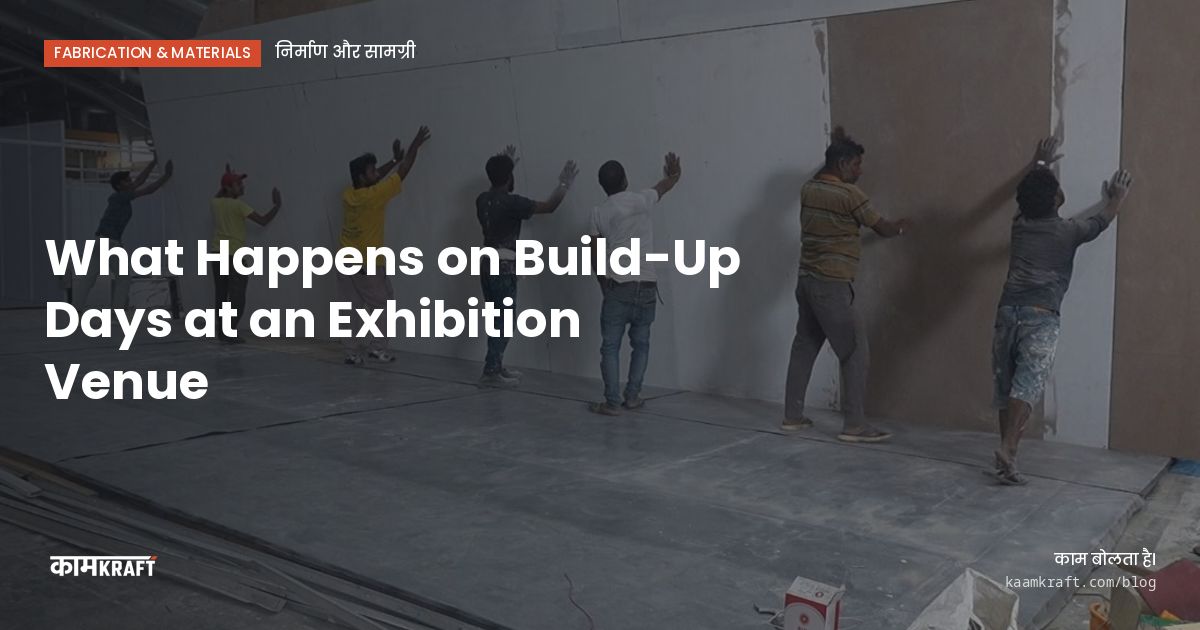
Build-up is the window before the show opens when every exhibitor's stall is installed at the same time. For a factory-built stall it follows a set order: unload, mark out, lay the floor, raise walls and fascia, fit electricals and graphics, connect power, clean, place products and hand over. The work is mostly assembly, because the cutting and finishing were done in the factory.
What makes build-up hard is not the work itself but the conditions: shared aisles, fixed hours, other contractors and organiser checks. Here is what happens, in order, and where you as the exhibitor fit in.
Before the crew arrives
The organiser's exhibitor manual sets the build-up dates and hours, vehicle entry rules, badge and pass requirements, and the deadlines for stall design approval and power requests. Every venue and show is different, so read it early and share it with your fabricator. If you exhibit at BIEC Bengaluru for one show and the Chennai Trade Centre for another, do not assume the rules are the same.
By the time the truck leaves the factory, these should be done:
- Crew badges and contractor registration completed
- Stall design approved by the organiser
- Power load requested and confirmed
- Truck entry pass and unloading slot arranged
- Insurance or other documents submitted, if the manual asks for them
- The site lead's number shared with your team
Day one: unloading and marking out
The truck is unloaded at the allotted point and parts are moved to the stall space. Before anything goes up, the site lead marks out the stall on the floor against the organiser's space markings, checks the corners and confirms the open sides. If the space on the ground differs from the drawing, this is the moment to raise it with the organiser, not after the walls are up.
Then the platform or floor base goes down, levelled to deal with any unevenness in the hall floor. Carpet or other flooring goes on top, protected with sheeting until the end of build-up. Everything above depends on a level, square base, so this step is never rushed.
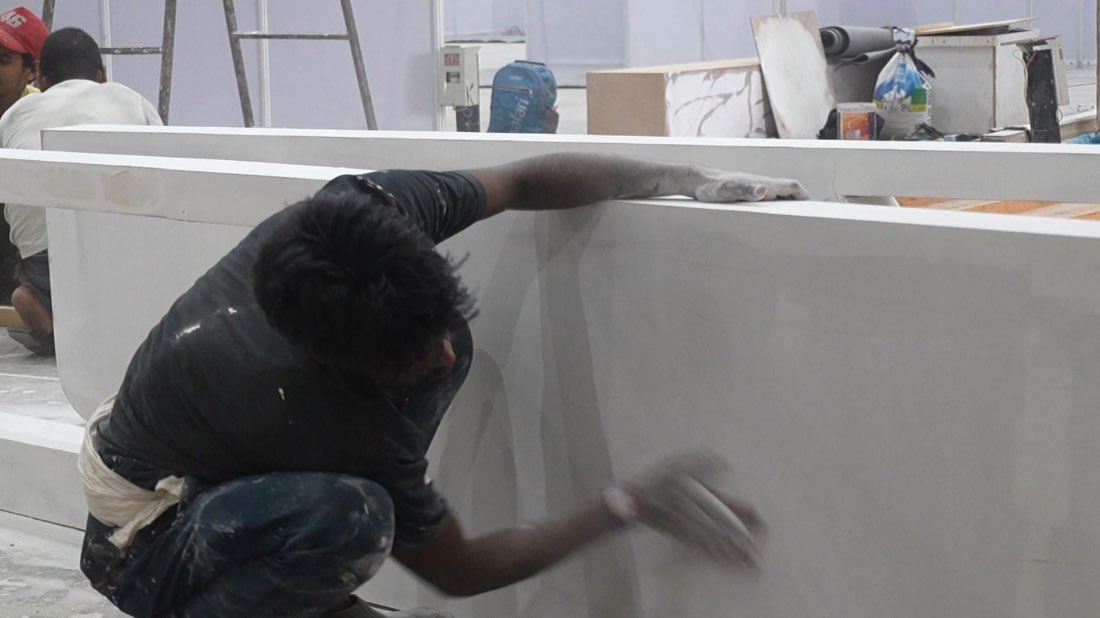
Raising the stall
Walls go up in the sequence worked out during the trial build in the factory. Panels are bolted together, joints aligned and braced. Fascias and headers follow, then counters, storage units, showcases and meeting room partitions.
Electricals come next: lights, connectors, the distribution board and cable runs to the venue power point. The official power connection comes through the venue's electrical arrangements as set out in the manual, and it may not be live until late in build-up. Graphics are applied or fitted, and any transit scuffs on paint are touched up where the rules allow.
Sharing the hall
Your neighbours are building at the same time. Aisles fill with crates, ladders and forklifts. A good crew keeps its materials inside its own space, works safely at height and talks to neighbours about shared walls and back panels. Organisers may inspect stalls for structure, height and fire safety during build-up, so the approved design needs to match what is actually being built.
The final hours
Once the structure is complete, the crew cleans every surface, removes packing and protective film, focuses lights and tidies cables. Empty crates go to storage as the organiser allows. Then your products arrive and are placed, ideally with someone from your team who knows how they should look.
We aim to hand over the stall with enough time for your team to set up brochures, screens and demo units without the crew still working around them. A walkthrough at handover covers storage keys, light switches, power points and who to call during the show.
Where build-ups usually go wrong
The common problems are rarely about the stall. They are late design approval, power not requested in time, badges not ready at the gate, products arriving on opening morning and nobody from the client side available to take a decision. Each of these is avoidable with a week of attention before the show.
On the stall side, the usual risk is a design change agreed by phone during build-up. A counter moved or a wall cut down on site may look minor, but it can affect wiring, graphics and the approved drawing. If something must change, agree it with the site lead, note it, and check whether the organiser needs to know.
Weather and traffic can also delay a truck on the way in. That is why we plan for the stall to arrive at the start of the build-up window rather than in the middle, so a late arrival eats into spare time instead of finishing time.
What exhibitors should do during build-up
- Send one person who can take decisions, ideally on the last day of build-up.
- Deliver products, screens and print material as agreed, not on opening morning.
- Check the stall against the approved design and raise concerns at handover.
- Test screens, demo units and equipment once venue power is live.
- Confirm badge collection for your stall staff.
- Save the site lead's number for the show days.
For a show such as Paperex South India 2026, at Chennai Trade Centre from 3 to 5 December 2026, this order applies in exactly the same way. Our exhibition stall service includes the crew, the build-up and support through the show.
Planning a stall?
Tell us your show and space, and we will plan build-up backwards from opening day. Start with Plan your project or WhatsApp or call +91 70190 58391.